Take me home, country roads. In your own time

As soon as I leave my driveway I’m on the open road.  The immediate road isn’t very open, winding up a mountain the way it does, but if I want to go anywhere else – which I usually do – I need to take State Highway 39.  State Highway 39 is long and mostly straightish and sealed and all the things that make you think, yes.  It’ll be a quick easy trip into town, why not?

Here’s why not.  State Highway 39, or at least our local stretch of it, is a scenic route.  It also runs through the middle of serious farming country.  It’s the quickest way for Aucklanders to go and play in the snow on winter weekends.  It’s a tourist route.  And it has no passing lanes anywhere and only a couple of stretches where, if all the planets are lined up exactly right, an overtaking manoeuvre might just sometimes be vaguely possible.
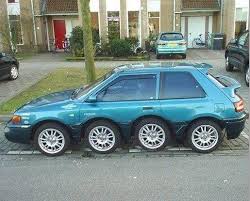
More wheels might help

More wheels might help

So at any time on any day you can pretty much count on getting stuck behind a combine harvester, a milk tanker, a campervan, a Sunday driver, a quad bike, an elderly person admiring the view, a retired farmer admiring the cows, and the school bus.  There’s a law that says you have to slow down to twenty to pass a school bus that’s stopped to let kids on or off, which is pretty much unnecessary because if you’re behind the school bus you’re doing twenty anyway.
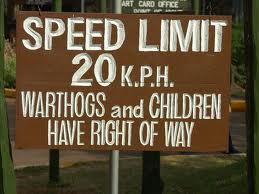
sign

One time I was stuck, down the entire length of the main street in Te Awamutu – the whole three blocks! – behind someone taking a tractor for a test drive.  I could tell because it had dealer plates.  This does not happen in Queen Street, people.  Though on average a tractor probably travels faster than Queen Street traffic even with the front loader attached.
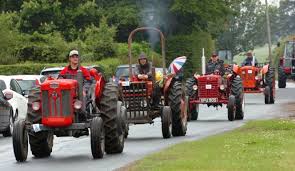
Te Awamutu at rush hour

Rush hour in Te Awamutu

As I was drifting home recently with plenty of time for my mind to wander due to the exceptionally slow pace being set by the octogenarian in front of me and the other twenty-five vehicles on her tail, it occurred to me that most of the drivers who come to my attention in this way can be broadly grouped into handy categories.  In case you find yourself on State Highway 39 at some point I thought you might benefit from my insights.  So here we go.
olddriver

First, you have your Chronically Unaware Driver.  Their distinguishing feature is that they pick a speed they’re comfortable with and stick to it no matter what.  Typically they will putter along the open road at eighty and will blithely sail through the seventy and fifty zones without changing speed at all.  Possibly they feel that it’s preferable to aim at an average rather than being picky about the details.  The risk for the rest of us when caught behind a C.U.D. is that we’ll go into a trance on the open road section, follow without thinking into the residential area and get a totally unfair speed camera ticket.
5under

Then you have your Hyperbolically Cautious (Ususally Elderly-Type) Driver.  As opposed to the C.U.D., these ones do take note of the lower speed limit areas.  Oh yes.  Although they considered seventy-five to be a comfortable speed on the open road, they feel it necessary to drop down to fifty-five in the seventy zone and thirty-five in the fifty zone.  No point in getting carried away.  The danger here for the rest of us is that we’ll forget we’re driving altogether and take a little nap instead.  A secondary (but very real) risk is that, when the H.C.(U.E.-T.)D. finally turns off into the driveway of the Golden Pastures Retirement Village, you’ll feel the sudden release of a cork popping from a bottle and will put your foot down hard with relief and get a totally unfair speed camera ticket, at which point you’ll feel like writing to the Police and seriously putting forward the averaging-out theory as a defence.

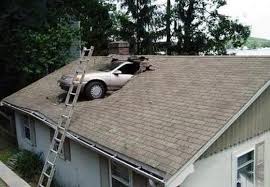
If you fall asleep, this might happen.

If you fall asleep, this might happen
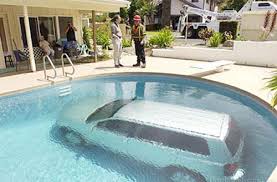
Or this.

Or this


Less likely, but it happened to somebody...

Less likely, but it happened to somebody…
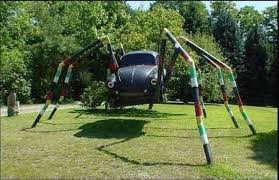
 

And then there's this.

And then there’s this.


Then there’s the Wildly Unpredictable While Trying To Be Considerate contingent.  You know what I’m talking about.  They’re humming along at ninety but veering all over the lane so you can’t overtake because you’re not fully convinced that they’re totally on top of this driving thing.  Then they notice you behind them and helpfully start driving with the left-hand tyres raising dust on the shoulder, giving you room to overtake which you still can’t do because, lunatic.  And yellow lines, approaching articulated truck and blind corner.  Driving on the unsealed shoulder slows them down even more, of course, and once they realise that you’re too much of a pansy to overtake when they’re so kindly giving you an opportunity they try to show consideration by speeding up to a hundred and ten on the long straight bit  – meaning that you still can’t pass them even if the planets are all lined up right – but reverting to their comfort zone between eighty and ninety-five for the rest of the trip.  The main risk here is debilitating cynicism, frankly, because you arrive home (eventually) wishing that your car was fitted with a flame-thrower even though you know they were truly trying to help you, and you hate what that says about you as a person and the human race in general.
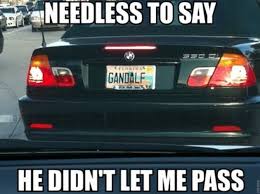
gandalf

Tractor drivers can’t really help it, and they’re not too much of an issue.  Although there’s always someone between here and school tootling along in something with wheels bigger than my whole car and some giant machine on the back that I can’t imagine the purpose of, although it’s clearly contributing to the country getting rich on butter and lamb, they tend to be going so slowly that they’re more or less standing still.  If you zoom around a tight corner and come across one you’ll be in trouble – whatever it might be on the back, it always includes many pieces of sharp metal poking out, usually with teeth – but apart from that they’re easy to nip around even in a pretty short clear space.  This came in handy yesterday because I had to nip around four, which is more than usual even here, along the 6.2km between school and home.  Four! And I like farm machinery, so there’s that.  The danger for me (and probably only me) is that I’ll be too busy gazing at it and wondering what it is and if by any stretch I might possibly need one, to look where I’m going.  I imagine the rest of you don’t have to worry about that.
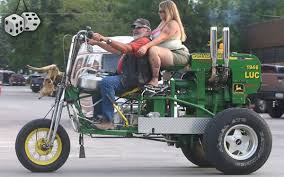
motorbike

Snow traffic.  This is what happens when there’s a bit of a chill in the air on a Thursday and every second resident of Ponsonby, Remuera, Epsom and Herne Bay says ‘I know!  Let’s throw the skis/snowboard in the roofbox and fill the SUV with bubbles and quinoa and head down to the mountain after work tomorrow!’  So on Friday nights there’s a procession of people driving in the dark trying to get to National Park as soon as they can and on Sunday nights the same shiny Remuera tractors are heading back with people who’ve worked a full week, spent the weekend packing in as much snowy activity as possible and driving for hours, at the wheel.  This has predictable results and is the focus every winter of a big effort by police doing checkpoints and road safety groups with their fatigue stops to try and get people to understand that it’s their playground but it’s our children’s road to school and home.  On Friday mornings in winter I can always tell when there’s been fresh snow on Ruapehu because I have to give way to more than one car before I can turn off to kindy.

This one time, I had to wait for ages because the hay on the back of a truck had caught on fire and nobody could get passed until it had gone out.  I am not even making this up.

This one time, I had to wait for ages because the hay on the back of a truck had caught on fire and nobody could get past until it had gone out. I am not even making this up.

Everyone around here has a 25,000 or 30,000 litre water tank or two.  Like this:
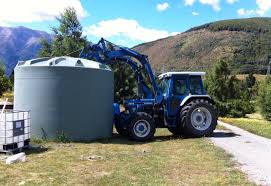
Not small, right?  And there's a tractor again

Not small, right? And there’s a tractor again

Do you know how you get a tank like this to your house?  Two at a time, sideways, on a truck with a sort of double cradle-type shape.  I see these often enough and think wow, they’re huge, and kind of unstable-looking but I’m sure the driver knows what he’s doing.  A while ago I passed by just after the tank truck had taken a corner a bit fast resulting in a squashed hedge, tanks-in-paddock scenario.  I was reminded of this today as I rounded the same corner and met an oncoming truck whose flatbed took up more than the width of its entire lane and whose cargo, a silo – a silo, people, bigger than ten tanks – kind of skimmed over my bonnet as it passed by.  At least I wasn’t stuck behind it.  I’m beginning to think I should just stay home.

The moral of this story is that you should always leave home early.  Take a John Denver CD to give you hope that you’ll get there eventually.  And maybe pack a flame-thrower.
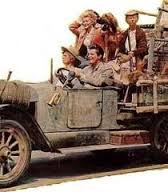
Now I'd better leave to pick up the kids.  I've only got half an hour and it's seven kilometres away.

And now I’d better leave to pick up the kids. I’ve only got half an hour and it’s seven kilometres away.


Posted in country life | Leave a comment

Why psychologists don’t drive Corvettes

A while ago a friend, whose children have various specific learning needs between them, made a comment something like this:  ‘I’d always assumed that when they went to school, whatever problems that came up would be dealt with by the teacher who would know how to do it because they’re the professional’.  In this family’s experience that hadn’t happened and the parents have spent large amounts of time and money over the years  – as have we – on research, assessments and outside-of-school educational support.

Because his comment accurately reflects our own experience, and because I’m a teacher and have seen the problem from the other side as well, I spent a while thinking about why this is.  Of course you expect that when you send your child to school to be educated the teachers – experts in educating – will be equipped to deal with all the different ways in which individual children need to be taught.

And because I know you’re just dying to hear my conclusions, here they are.

If you’re sick or injured, you go to the doctor.  Usually you go to a G.P. The G.P. will fix all manner of everyday and minor things like sore throats and infected wounds and sprains.  They can often also fix the common major stuff like depression and high blood pressure right there in their office.  But an important part of the role of a G.P. is to know when to refer you to someone else who specialises in the part of the body in which your problem lies.

This is because the human body is more complicated than a layperson like me can begin to imagine.  The medical profession has always recognised that it’s ridiculous – and dangerous – to expect any one individual, let alone all of them, to be able to fix absolutely anything single-handedly that comes their way.  You do not expect your G.P. to whip you up onto the table for open-heart surgery.  Nor do you expect them to cure your cancer.  What you expect them to do is recognise that you need the surgery or have the cancer, know the appropriate specialist to send you to, and look after any follow-up care that might be required.

If the human body is complicated, the human brain is even more so.  It still holds many more mysteries in how it develops and functions than the body does.  There is so much about it that we don’t know.

Back in the old days teaching was easy.  You talked and wrote on the board, the kids listened and copied and either they learned or they didn’t in which case you gave them the strap for being stupid and they left school at fifteen to work in a garage.  Nothing complicated about that, because the idea that people’s brains are wired in all sorts of different ways and learning comes in all sorts of different forms wasn’t widely accepted.  Dyslexia, Asperger’s Syndrome, ADHD and Irlen’s Syndrome hadn’t been invented yet and when kids didn’t do well at school it was because they were thick or naughty or both.

Now we know it’s not that simple.  We know that many people are wired to learn differently from the conventional model and I would argue that teaching children with dyslexia, for example, is as much a specialist area as heart surgery, and with similarly life-long effects.

Now I put on my teacher hat.  You have a classroom full of small children and you know who’s doing okay and who’s not, but sometimes you don’t know why.  Sometimes you know exactly why but you’ve been trained as a G.P. – a general practitioner – and although you can see the need for heart surgery all you have is aspirin.  It is intensely frustrating but you hand out the aspirin and keep on going.

Teachers are like your family doctor except that as a teacher, when you have a situation that calls for specialist support, there usually isn’t a specialist there to refer to so you just have to do the best you can.  And we end up with the educational equivalent of patients who’ve been given an aspirin when they needed heart surgery and anti-depressants when they needed a psychiatric hospital.

My dream as a teacher would be this: I would be fully trained to recognise learning and processing disorders very early.  When I recognised that a child had dyslexia I would refer them to the specialist dyslexia teacher.  When I found one with Asperger’s Syndrome I would refer them to the appropriate person.  When I knew that something wasn’t quite as it should be but didn’t know why I’d refer them to the expert in Working It Out.  This is not to say that I’d want these groups of children taught separately from others; just that I’d have experts to work in conjunction with to make sure that all of their particular needs were being met.

These specialists do exist but they’re very thin on the ground and a child usually has to be in a pretty bad way to qualify for the help, by which time they’re often already far behind.  As we found out, the facility for diagnosing disorders like dysgraphia doesn’t exist at all within the public school system because there are so few people qualified to do it and the need hasn’t been fully recognised.  So why?  Why does the medical profession have this model of G.P.s who act as a combination triage and clearing house, with specialists in every field you can imagine to back them up, and education doesn’t?  Are our brains not as important as our bodies?

I once used the services of a medical specialist whose mode of transportation was a blue convertible Corvette with a personalised number plate and surround which said ‘Smooth OPER8R’.  I should have turned right around when I saw that in the carpark, but however.  If we can overlook his terrible taste for a moment I think the answer lies right there: money.

Training as a medical specialist is long and hard but there is compensation at the other end in the form of very good money.  I’m not for a minute saying that that’s why people become doctors; from what I’ve seen as friends have gone through the process you’d truly have to be passionate about the job to stick with it long enough to pay off your student loan, let alone be in the market for tacky cars.  But there is certainly a recognition that that sort of income means your position in society is highly valued and that you deserve the fruits of your hard work of helping all the rest of us to have the best quality of life that we can, at least health-wise (which is a pretty big part of it).

Educational psychologists do not drive Corvettes.  When we needed someone to diagnose Daniel’s dysgraphia we discovered that there are very few people qualified because conditions like dyslexia, dysgraphia, dyscalculia and dyspraxia are complex, teaching people with them is even more so, and the training to become an expert in this field is long and expensive and not at all lucrative.

Once again, I know that people who work in education generally do so because they’re passionate about it, and offering them vast sums of money to become dyslexia specialists isn’t necessarily any kind of solution.  Maybe it’s not the money itself but the recognition factor.  We pay highly those we value highly.  This is why the teachers’ unions spent many years campaigning for better pay and for entrenched equality between primary and secondary teachers.  When I was in teacher’s college pay was low – when I started work I was earning $26,000 and my mother, with her many years of experience, wasn’t getting much more – and secondary teachers earned more than primary.  The message was clear that teaching was a low-status profession and that primary teachers were barely-skilled babysitters.

That has changed.  Teachers’ pay scales are now perfectly respectable and I believe that their status has risen accordingly.  But we’re not there yet.

Everyone needs doctors from time to time.  Having incentives, monetary or not, in place to make sure that there are always people willing to invest enough time and effort in becoming specialists to back them up is critical to living in a society where everyone can be free to experience the best health possible.

Everyone needs education, too.  Teachers are well trained to deal with all the common, everyday needs likely to pop up in a classroom, but they are not equipped to be heart surgeons or cure cancer.  If we want to advocate for our children, this is the area of most need – investment in educational specialists.  My heart-felt advice is this: vote for whoever’s ready to offer free Corvettes to psychologists if that’s what it takes to raise the profile and status of the people who do for our children’s minds what a heart surgeon would do for their bodies.

Of course money is not the only factor here.  There’s also the fact that awareness of all the learning difficulties which can hold a child back is still relatively low.  We know much more about problems affecting the body than we know about learning processes and the issues that interrupt them, and as teachers we still deal with people who believe that kids today are just spoilt and lazy.  But until more people are qualified and working in this field, and are recognised as making an essential contribution to raising the quality of education across the board, it won’t be given credence as a valid area requiring resourcing, research and innovation.

How to achieve this?  I don’t know.  Maybe, if your child is interested in becoming a teacher, encourage them to aim high and specialise.  One day they might even be able to drive around in a Corvette whose plate says ‘Smooth EDUC8R’, and who wouldn’t want that?


Posted in education | Leave a comment