
My election manifesto, if only someone would listen

This morning Daniel was still asleep when his brother and sister left on the school bus and his father left for work.  I went and prodded him into semi-wakefulness and before his eyes were fully open he started whingeing about having to go to school.  He got up and grumbled and moaned his way around his morning jobs and then just started begging.  School’s boring.  He hates it.  They have spelling tests on Fridays.  Apart from lunchtime there’s nothing fun at all.  He’s one of only three poor deprived kids in the class who haven’t had a day off all year.  Some of them have been on two-week holidays overseas during term time.  What’s one day off going to matter?  It’s not like the cops are going to turn up and find him at home instead of school.

For me this is a very unwelcome blast from the past.  We have suffered through years of this on a daily basis, sometimes with the added fun of Josh having to carry him kicking and screaming and physically strap him into the car.  There have been many, many times when I’ve watched with a breaking heart and wondered what we’re doing to him and why, exactly.  We have certainly considered other options, often, but none of them have been right at the time either.

IMG_8858

Daniel has dysgraphia which means that he loves Lego and computer games but hates reading and writing.  He has a learning style called 3D visual-spatial which schools haven’t really discovered yet.  He’s also borderline hyperactive so that if whatever he’s supposed to be doing at school isn’t quite working for him he’ll find some other way to entertain himself rather than  self-consciously blending into the background.  Daniel does not blend.  He scores in the high 90s on the percentile charts in many elements of the intelligence test so he cannot be fobbed off with a colouring-in sheet and a picture book.

As a teacher a child like this is either your worst nightmare or an exciting, if challenging, opportunity.  For the last year and a half we’ve been lucky enough to have had teachers for Daniel who see potential and value in him and who realise that the irritating class clownism and constant activity are symptoms of an environment that’s not a perfect match for his learning style, rather than being the sum total of his classroom ability.  It’s been a huge relief to us and a far less miserable experience for Daniel and the crying and pleading in the mornings has largely disappeared.

Here’s the sad thing about Daniel:  he wasn’t always this way.  As a pre-schooler he was the most co-operative, charming, easy-going bundle of fun around.  He was active, yes, but always pleasant and positive and bright-eyed and bushy-tailed.  Kindy had no complaints about him and nor did anyone else.  He started school with a wonderfully competent and experienced new entrant teacher and the future looked rosy.

IMG_3536

Now I’m a trained teacher and a parent of many small people on the road to literacy and numeracy and here’s my professional opinion, for what it’s worth.  We do not need to spend $300 million on bringing class sizes down.  We do not need more teachers.  We do not need more managers in schools or any of the other things that I’ve seen waved around as election promises with big price tags.  What we need, what we desperately need, is for all teachers to be trained to recognise children with dyslexia, dyspraxia, dysgraphia, dyscalculia and all the other dys-es very early; for there to be a whole army of people trained to work with these children effectively; and for there to be some sort of pre-school screening programme so that ideally these children never have to arrive at school only to be put into the situation that Daniel found himself in for years until we, the parents, against the principal’s advice and at our own cost, did something about it.  And yes, this is a big-budget deal.

Because here’s what happened to Daniel.  He got to school, all keen and ready.  Then he found that when the teacher taught he didn’t learn.  For several years he didn’t learn and all that time people kept telling him, you need to try harder.  You need to concentrate better.  Sit still!  You need to be spending more time on homework.  So he did all those things and when he still didn’t learn he was told to do them some more.  And some more.  He was kept in at lunchtime to finish work he hadn’t finished in school time.  He was given more spelling words to learn so he wouldn’t fall so far behind because he hadn’t managed to learn the last lot yet.  And our school has this wonderful policy – with research to back it up, no doubt – of putting little photos of all the kids’ faces against the levels they’re at for every subject on the classroom walls.  So all this time Daniel knew that every parent, teacher and child could always see at a glance that he was on spelling list C even though he was in year 4 and everyone else was on M or S or W.  And just try telling the teacher that you don’t want that little photo on the wall.  It motivates them to do better, apparently.  When you ask, if that was going to work don’t you think he’d be further along than set C after four years at school, they say well, if he would just concentrate harder and if you were doing more homework with him.

IMG_8896

A few nights ago we had parent interviews and the picture I get from the teacher is this:  Daniel is doing fine for his age in most things and very well in some.  Spelling is a dead duck and anything that has to be filtered through the medium of writing suffers but he has lots of good things going on.  We are saving up to get him an iPad with a word processing programme said to be ideal for this type of thing and, once the obstacles of spelling and handwriting are bypassed, miracles will follow.

But that’s not how Daniel sees himself.  No, sir.  Daniel thinks he’s dumb.  He believes he won’t be able to do it anyway so what’s the point in trying.  He knows he’s never going to get attention for his achievements at school so he makes sure he’s not overlooked by use of constant smart-arse comments and an often mis-timed sense of humour.  His first few years of school provided constant failure and frustration for which he could see no reason.  And now he’s more handicapped than he was before we had diagnoses for his various quirks because it’s his attitude and his self-belief that are wrecked, not his brain.  And although he’s far better off now thanks to his current teacher, I do not know if he can be fixed.  We won’t be getting back the sweet, happy little boy we sent off to school five years ago.  I have grief to work through there.

Depending on whose statistics you believe between 6 and 10% of people have one or other of these dys-things going on.  Teachers are not trained to pick it up and if parents suspect it and want it assessed there is no facility for this to be done within the school system.  You have to do it privately and it costs an arm and a leg.  When I first mentioned the possibility to the principal she said, ‘Oh, dyslexia.  Yes, we had a child with that here a few years ago’. No, lady, in a school of 300 you have somewhere between 20 and 30 children with it right now, and every single one of them is struggling and miserable, and a fair few will be creating behaviour problems to deal with their boredom and frustration, as Daniel did.

This is why we do not need to spend hundreds of millions on extra teachers to get classroom sizes down a bit.  If every child with one of these processing disorders was picked up before or at school entry and was taught by someone who knows what they’re doing we could increase achievement and participation as well as eliminate most of the time-consuming and distracting bad behaviour from classrooms.  Class size is a red herring.  It doesn’t matter.  What matters is how many children within the class are taking up disproportionate amounts of the teacher’s time and energy.  Most children who do so are not inherently bad or naughty; in junior classes they’re children who want to do well and be ‘good’ but who can’t, for whatever reason, engage fully with the class programme.  If you have two or three Daniels in every class, which statistically you will, and you have parents who may not have the knowledge and resources that we did to deal with it themselves, you’ve got a problem which is only going to get worse as those Daniels get older and further behind and their attitudes of uselessness become entrenched.  It’s also, of course, a huge waste of potential.  Like Daniel these kids tend to be bright and after years of failing to learn and being told it’s their own fault all that ability and promise is going to be lost.  If the government has a spare $300 million burning a hole in their pocket then this is where it needs to be.
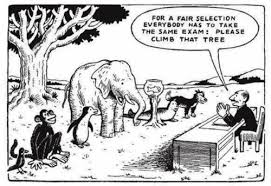
fair education

Ultimately I know that Daniel gains more from school than he loses, whether he sees it that way or not, which is why we persevere.  But it shouldn’t be something we have to balance up; he shouldn’t be losing anything by going to school.  He shouldn’t have to lose his self-belief and his joy in learning and we shouldn’t have to lose the lovely little boy that he used to be.  The enduring lesson we’ve learned as parents is that if we believe that something is right or wrong for him and the teacher and/or principal disagrees we need to follow our own instincts.  A lot of misery could have been avoided if we hadn’t believed several years’ worth of teachers when they said that he was fine, that there were no underlying problems and that we couldn’t possibly know what we were talking about.  Which is why I’m so torn when I have to bribe him with a treat after school to get his defeated shoulders and sad face into the car in the morning.  How can I expect him to trust that adults know what’s best for him when between us and school we’ve spent almost half his life putting him through the soul-destroying daily grind of forcing him to jump through hoops that he can’t even see and then blaming him for not trying hard enough when he misses again?




Posted in education, kids | Comments Off on My election manifesto, if only someone would listen

His purest word was mercy

Song: My Love Came Through the City

My love came through the city
And they did not know him
With his beard and his eyes and his gentle hands
For he was a working man

My love stood on the lakeshore
And spoke to the people there
And the fish in the water forgot to swim
And the birds were quiet in the air.

‘Truth’ — he said, and — ‘Love’ — he said,
But his purest word was — ‘Mercy’ —
And the fishermen left their boats and came
To share his poverty.

My love was taken before the judge
And they nailed him on a tree
With his strong face and his long brown hair
And the whiteness of his body.

‘Truth’ — he said, and — ‘Love’ — he said,
But his purest word was — ‘Mercy’ —
And the blood ran down and the sun grew dark
For the lack of his company.

My love was only a working man
And now he is God on high;
I have left my books and my bed and my house,
To follow him till I die.

‘Truth’ — he said, and — ‘Love’ — he said,
But his purest word was — ‘Mercy’ —
Flowers and candles I bring to him
And no man is kinder than he.

– James K Baxter
From Collected Poems
Oxford University press, 1979

spacer-swirl-th

The late great James K. Baxter spent his adult life both exhilarated and tortured by trying to get his head around the ideas of God, religion and the overlap between the two.  I don’t know that he was convinced that there is much overlap sometimes and I don’t know that I am either.

James k baxter

Say what you like about his mental state and his choice of pharmaceuticals, there’s no doubt that the man knew how to string words together.  Here’s the thing I’ve always loved about this poem: it’s so simple.  It summarises Jesus and his message in a few simple words.  He was a working man, his message was love, truth and mercy, and it was so striking – so powerful – that the birds forgot to fly and the fish forgot to swim.

So here’s what I’m asking.  Can’t we please just stick with that?

I’m not much of a Christian and I don’t like labels so truth be told, I probably wouldn’t call myself one at all.  On a good day I believe in God and that’s about as far as I’m willing to commit without feeling that I might be overstepping my integrity.  Back when we lived in town we did go to church every Sunday because we were lucky enough to live just down the road from one that we liked.  My needs are simple; I just want one with a créche.  But Josh has a theology degree and can read the Bible in the original Greek so for him the important thing is finding a preacher who’s not of the leave-your-brain-at-the-door variety.  Josh wants to hear sermons that challenge him and give him new ideas and are based on sound Biblical and historical knowledge.  The minister of this church is intelligent, knowledgeable and a good speaker and his wife runs a kids’ programme with biscuits so our family was all sorted.  When we moved out of town we got very slack about managing to get there but this year, finally free of children small enough that they need to nap in the a.m., we started making the effort a bit more often.

But oh dear.  Oh dear.  The Anglican Synod have said that, although gay marriage will not be recognised in the forseeable future they are working towards finding ways in which ministers who feel comfortable with it will be able (but not compelled, now or ever) to bless same-sex couples and possibly even make them feel a bit more welcome inside their walls. (Go to Features, Extras, A Way Forward.  They use weird non-linking links.) And our lovely minister can’t work within a denomination which will allow that maybe sometime it will be kind of okay to be gay AND a Christian, so he has resigned and taken most of the congregation with him.  It was a church that had a lot going for it and it met our family’s needs very nicely but as for me and my household, we will not be aligning ourselves with a minister and congregation who would split from their church over any issue and particularly not over this one.

Because here’s the thing:  none of us can be certain – not really really certain, not enough to wreck lives over it – that what we think God thinks, really is what God thinks.  Many Christians will tell you that one of the reasons why church is more relevant than ever nowadays is because in this age of tolerance and anything-goes, someone has to stand up for the moral absolutes.  But the danger of hanging your hat on something absolutely is that, whether you admit it or not, you might be wrong and so you need to pick your absolutes very, very carefully.

Here’s the thing about the Bible.  You can pick any proposition – almost any at all – and you can find a verse in the Bible to support it.  Or negate it.  Whatever.  Because the Bible is not a structured, orderly, step-by-step instruction manual.  Far from it.

You’re not supposed to murder people, of course.  But then God did quite a lot of smiting, sometimes for almost no reason at all.  The Bible does, in fact, proscribe putting people to death for a wide range of things including adultery and sleeping with both a woman and her mother.  It seems as though killing people can occasionally be justified.  So does the Bible say it’s never okay to take a life under any circumstance, as the pro-life lobby maintain?  I don’t know.  You can argue either way from the evidence in the book.

Slavery is more or less endorsed in the Bible which came in handy for the Church of England.  They worked their way through far more slaves for far longer, and in much worse conditions (if you can believe it) on their sugar plantation in the West Indies than any slave owner in America.  I think we all pretty much agree now that slavery is terribly wrong and that God must surely view it as sinful, but good luck if you’re looking to back that up with Biblical proof.  You will find rules on how to treat your slaves and how to deal with runaways, but as to whether it’s right or wrong?  Nada.

People who use the Bible to justify things often make a clear distinction between the Old and the New Testaments in order to not have to explain away all those pesky bits like how Biblical family values were all about how much you could get for your daughter.  The New Testament did away with all the morally ambiguous stuff and anything that remained can be trusted as being for sure what God really meant.  So let’s have a look.

Well, there’s the part where Jesus says that if a divorced woman remarries she’s committing adultery, as is the man who marries her, which is punishable by stoning to death.  Marriage is for life, obviously.  Fair enough.  Except that in that culture at that time a divorced woman had only two options for supporting herself and her children if her family wouldn’t take her back: prostitution and begging.  Are we to believe that Jesus thinks it’s better for a deserted wife to spend the rest of her life doing either or both of those than to remarry?  The evidence certainly points that way but it would be inconsistent with so many other things that Jesus said about compassion and mercy that I don’t believe we can take it at face value.  The New Testament is also clear on the fact that it’s not okay to leave your husband, ever.  Unambiguous.  We don’t hold people to that though, because we know there are times when it has to be done to save someone’s sanity or their life.  Was there no domestic abuse in Jesus’ time?  Of course there was.  Women barely even qualified as people.  So why would the Bible seem to say, tough, suck it up?  We don’t know.  It’s there for a reason but maybe not a reason that relates to us in the way it appears to.  It was written at a specific time and in a specific context and it may or may not apply to all people at all times.  We don’t know.

Leviticus tells us that homosexuality is sinful and wrong.  It also tells us that about wearing clothes with mixed fibres, eating food with blood in it, and being seen with your head uncovered if you’re a woman.  You don’t see Brian Tamaki marching down Queen Street protesting about how the moral fabric of society will be rent in two by people who wear woollen coats with cotton linings, though, do we?  Why not?  Well, we can’t see any particular reason why those rules should be important so we ignore them.  We say, it doesn’t count because it was in the Old Testament.  Is this causing God distress?  We don’t know.  We don’t know, so we have to use our brain.  My brain tells me, for example, that God is not in favour of people hurting each other and so we can be pretty sure it’s okay for society to punish and restrict the freedom of rapists, thieves, drunk drivers and similar. We can’t have people running around freely engaging in all these behaviours because they take away from other people.  How we treat those whose main goal in life is to be free to love and devote themselves to a partner of the same sex, however, and who aren’t in the least bit interested in impacting on the rest of us, seems to be to be an entirely different kettle of fish.  We make our best judgement using the very few consistent guidelines that run through the Bible as summed up by the man himself:

‘Jesus replied, ‘Love the Lord your God with all your heart and with all your soul and with all your mind.  This is the first and greatest commandment.  And the second is like it: love your neighbour as yourself.  All the Law and the Prophets hang on these two commandments’.  Matthew 22:36  (NIV)

What am I trying to say here?  Just this: when we try to work out what God wants of us, or really means, or finds right or wrong there are so many times when we have to say we just don’t know.  Why does the Bible allow slavery, but not divorce for abused wives?  We don’t know.  Does it really mean that deserted young women are better off begging and selling themselves than remarrying?  We don’t know.  It’s not the Road Code with everything you need to know all laid out step-by-step so you can be sure you’re a hundred percent right.  It’s not the Edmonds Cookbook, either – follow the instructions exactly and get a guaranteed outcome.  No sir.

So when we say, the Bible says that any particular thing – abortion, divorce, homosexuality – is absolutely wrong in every possible circumstance, can we really be sure?  Can we be so sure that we’re willing to compromise other people’s lives over it?  To make laws to ensure that some people remain second-class citizens?  To say, as though we’re God or something, that a certain group of people do not deserve the joy of children in their lives?  Can we really be that sure?

I say no.  If you’re claiming that degree of certainty as to the mind of God you’re getting pretty arrogant, in my opinion, and arrogance is a dangerous thing.  But we all, individually and as a society, need a moral compass so what are we left with?

James K. knew.  He picked it right.  We’re left with love, truth and mercy.  When we can’t be certain what God meant we go along the path of mercy.  Because if there’s one clear and unambiguous passage in the Bible, that one a few paragraphs back is it.  Love God and love your neighbour.  When in doubt do the kind thing.  Do the loving thing.

So I can’t stay in a congregation who are so certain they have it right that they’ll cause a church split over it.  That’s no way to deal with your differences.  I have no doubt that they have the very best of intentions and are following their own personal beliefs to the best of their ability and I’m sure God appreciates that whether he applauds their statement or not.  But there are two possibilities for how God thinks of homosexuality (and everything else): it’s right or it’s wrong.  I’d rather be the person who gave them the benefit of the doubt and treated them with kindness when God thought it was wrong than the person who told them they’re not welcome to marry and baptise their babies in my church when God thought it was right.  If there’s one thing I can be sure about from my reading of the Bible it’s that God’s not going to hold it against me if I have love and kindness as my default setting and leave all the judging and punishing up to him.  I think it’s a win-win, and if I don’t have God on my side I at least have James K. Baxter.

Posted in faith | 1 Comment